Meet
Dr. Bill
Meet
The Team
What Sets
Us Apart

Keeping Your Teeth Strong and Healthy

August 19th, 2020

What is the strongest part of our bodies? Do you think it might be our bones, which help us move and protect our brains, hearts and other organs? Or could it be those tough fingernails and toenails that guard our fingertips and toes? Nope! You might be surprised to learn that the hardest thing in our bodies is the enamel which covers our teeth!

Our bones grow with us and can even knit back together in case we have a broken arm or leg. Our toenails grow more slowly, and our fingernails grow more quickly, so regularly trimming is required for both. But our enamel doesn’t grow or repair itself when it is damaged, so it needs to last us a lifetime. How can such a strong part of our bodies be damaged? And can we do anything to protect our teeth? Luckily, we can!

Prevent Chips and Cracks

You might be the fastest on your bike, or the highest scorer on your basketball team, or able to do the most amazing tricks on your skateboard. But even the strongest teeth can’t win against a paved road, or an elbow under the basket, or a cement skate park. If you’re physically active, talk to us about a mouthguard. This removable appliance fits closely around the teeth and can protect your teeth and jaw in case of accident. And protect your enamel even when you’re not being adventurous! Don’t bite down on ice cubes or hard candy, and save your pens and pencils for writing, not chewing.

Guard Your Teeth from Tooth Grinding

If you grind your teeth, you’re not alone! Many other young people do, too—mostly in their sleep. In fact, it might be a parent or sibling who lets you know you are grinding at night. But constant pressure on your enamel can lead to cracked enamel, sensitivity, and even worn down teeth. How can you protect them? Once again, a mouth guard can be a great solution. We can custom fit one to allow you to sleep comfortably while protecting your teeth.

Eat Healthy Foods & Brush Regularly

We all have bacteria in our mouths. Some are helpful, and some are not. The bacteria in plaque can change food products like sugar and starches into acids. These acids actually break down our enamel, which can lead to tooth sensitivity and decay. Making sugars and carbs a small part of your regular diet, and eating meals rich in proteins, vitamins, and minerals, will help stop acids from attacking your enamel. And careful brushing and flossing twice a day with a fluoride toothpaste can help keep those minerals in enamel from breaking down and even help restore them.

Your enamel is the strongest part of your body, and you can help it stay that way. Protect your teeth from accidents, let our Dallas team know if you or a parent suspect you are grinding your teeth, eat healthy foods, and keep up your regular brushing. And remember, we are here to help keep your family’s teeth and mouth their healthiest for your strongest, most beautiful smile.


Periodontal Disease Associated with Cardiovascular Risk

August 12th, 2020

We all know that brushing your teeth and flossing regularly keeps your smile sparkly and bright, but did you realize that cleaning your teeth can actually help your heart? Recent research suggests that people with periodontal disease also have a higher cardiovascular risk, which means they are more vulnerable to heart attacks or stroke. It’s probably not time to throw away those running shoes in favor of a new toothbrush, but this is an added incentive to maintain good oral hygiene.

Relationship between Periodontal Disease and Cardiovascular Health

In 2003, researchers from the University of Buffalo conducted analyses which suggested that patients with gum disease were also at elevated risk of cardiovascular problems. Furthermore, people with more severe cases of gum disease have even poorer heart health. Although the exact causes of this relationship remain unknown, scientists continue to explore the impact of oral hygiene on broader health.

One hypothesis is that poor oral hygiene leads to inflammation, which negatively affects the heart. Gum disease occurs when bacteria build up in the mouth, and feed off sugars found in food. These bacteria release compounds that contribute to inflammation and red, swollen gums. The same inflammatory compounds may affect the heart, increasing overall cardiovascular risk.

Protect Your Teeth, Protect Your Heart

Taking a few commonsense measures can go a long way to improving your oral health and your cardiovascular risk. Consider the following:

  • Brush twice daily, and floss at least once per day. Brushing your teeth at least twice a day cleans away the harmful bacteria that contribute to gum disease. Similarly, flossing your teeth ensures that dangerous bacteria that build up between each tooth get swept away. These simple steps are the easiest ways to reduce your risk of periodontal disease.
  • Eat healthy foods. Those sugary snacks that you love so much don’t help your teeth. Whenever possible, stick to a healthy diet of fruits, vegetables, and whole-grain foods. For example, grab an apple or a few celery sticks for a mid-afternoon snack, rather than indulging in that candy bar.
  • Drink water. Staying hydrated doesn’t just help your body – it also swishes bad bacteria away from your tooth and gum surface. Drinking plenty of water improves your overall oral health. It’s particularly helpful after eating a sugary or sticky snack, because water can reduce plaque buildup.
  • Visit Whitley Family Dental. Dr. Bill Whitley and our staff will monitor your mouth for signs of periodontal disease and can make specific recommendations to keep your mouth – and your heart – safer.

Teeth Grinding

August 5th, 2020

If you are waking up with jaw pain, tension headaches, or facial pain, you may be suffering from a condition known as bruxism. This means you could be grinding or clenching your teeth while you sleep. Some people aren’t even aware they are grinding or clenching their teeth at night, until a visit to us reveals significant tooth enamel loss. Fortunately, there is a non-invasive and effective solution for teeth grinding, and the tooth enamel damage it can cause, in custom-fabricated nightguards.

Causes of teeth grinding

Tension, stress, and anxiety experienced during the daytime can carry over to an individual’s sleep, and lead the person to grind his or her teeth together or clench the teeth unknowingly. Sleep apnea is another condition that can result in bruxism. Regardless of the cause, however, frequent clenching and teeth grinding wears down the chewing surfaces of the teeth, reduces tooth enamel, and can result in a cracked or chipped tooth, crown, or filling.

Nightguards for teeth grinding

Custom nightguards are fabricated to fit like a glove and protect your teeth from the adverse effects of bruxism. Nightguards are created through a non-invasive process that simply takes an impression of the bottom and top rows of teeth. The result is a nightguard that is flexible, comfortable, and personalized to your mouth.

Benefits of nightguards

Nightguards are helpful to reduce or eliminate the symptoms of dental damage incurred as a result of teeth grinding. They can reduce the discomfort associated with a sore jaw, headaches, tooth sensitivity, ear pain, and facial pain that many patients experience as a result of clenching or grinding of their teeth. In severe cases of bruxism, patients can develop loss of hearing, jawbone misalignment, and TMJ. Therefore, customized nightguards can help prevent the progression of teeth grinding into these more serious conditions.

At-home tips to reduce or prevent teeth grinding

Although it’s important to wear your nightguard faithfully if you grind your teeth at night, you can follow a few self-care tips to help to prevent your teeth grinding from worsening.

  • Reduce tension and stress. Whether you take a warm bath before bed, listen to soothing music, or exercise, practice stress-relieving activities to wash away the tensions of the day.
  • Avoid alcohol. In some patients, alcohol increases teeth grinding tendencies.
  • Avoid caffeine. In some individuals, caffeine increases the likelihood of teeth grinding.
  • Focus on relaxing jaw muscles. Make a conscious effort to keep your jaw relaxed. A warm washcloth against your cheek, sticking your tongue between your teeth, and avoiding chewing pencils, pens, and gum are all ways to train the muscles of your jaw to stay relaxed.

If you suspect you may be grinding your teeth at night, visit Dr. Bill Whitley and our team at Whitley Family Dental for an evaluation at our convenient Dallas office.

Take Your Pick!

July 29th, 2020

Before electric toothbrushes, before dental floss, before fluoride rinses, in fact, before recorded history, people who cared about their dental health had one primary tool—the toothpick. Ancient bronze toothpicks, bejeweled Renaissance picks, and the more humble modern wooden picks have been instrumental in promoting dental hygiene for centuries.

And, while that clean, simple design is still a good one, modern technology has found a way to build an even better toothpick. Today’s interdental picks not only dislodge food particles effectively, but now gum stimulation, cleaner orthodontic appliances, and fresher breath are available literally at our fingertips. Most important, these picks are just as effective as floss for removing plaque.

  • Wood? Still Good!

Today’s softer wooden picks come in several shapes designed to fit comfortably and snugly between the teeth. Using a gentle in-and-out motion, you can clean between your teeth as you remove plaque from the tooth surface. But that’s not the only benefit! As you move the wide end of the pick up and down between teeth and gums, you are actually stimulating your gum tissue as well.  They even come with mint flavoring to refresh your mouth as you clean. And, of course, wood and bamboo picks are biodegradable.

  • Plastic? Fantastic!

If you’d like something a little more yielding than wooden dental picks, you have options. Soft dental picks are available that use rubber “bristles” on a plastic stem to gently ease their way between teeth. The heads are available in different diameters to accommodate tight or wide spacing between the teeth. Straight or curved stems provide the accessibility you need. If you have latex allergies, be sure to choose a rubber product that is latex-free.

  • Interproximal Brushes? Here’s What the Buzz Is

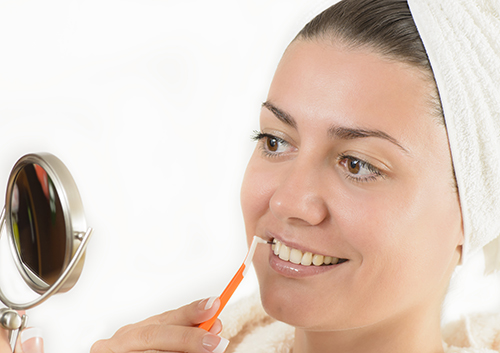
You might have missed these miniature brushes in the dental care aisle, but they are worth looking for. Interproximal brushes have small cone-shaped heads with nylon bristles for cleaning food particles and plaque from between the teeth. They are good for more than one use, and some are available with angled or bendable handles for hard-to-reach spots. They come in different diameters, from wide to extremely fine, to suit the spacing of your teeth. Interdental brushes are especially useful for braces wearers, who can use these clever tools to clean tight, tricky areas under wires and around brackets.

Even though bronze, bejeweled, or golden toothpicks aren’t available in the dental aisle of the local drugstore, increased efficiency and function are well worth the trade-off. If for any reason you have trouble flossing, or if you like the idea of massaging your gums as you clean your teeth, or if you wear braces, or if you want a burst of mint flavor—for any number of reasons today’s dental picks are worth a try. Talk to Dr. Bill Whitley at your next visit to our Dallas office, and we’ll be happy to give you some recommendations.